Inquiry

Leave Your Message

7 Best Compliance Checks for Global Nic Salt Vape Buyers

Global sourcing of Nic Salt Vape E-Liquid requires more than comparing prices or checking a bottle’s label. Product definitions, nicotine limits, ingredient rules, packaging standards, and import documents can differ by destination. Small details matter: a mismatched batch number or an unclear ingredient record can delay a shipment.

The scale makes careful checks essential. The World Health Organization’s 2021 global report estimated 82 million e-cigarette users worldwide. Its 2023 report on e-cigarette regulation also documented widely differing national approaches. These figures describe a fast-changing market, not permission to sell in any particular country. Buyers should verify current requirements with relevant authorities and qualified compliance professionals.

WHO Director-General Dr. Tedros Adhanom Ghebreyesus warned, “History is repeating itself, with the tobacco industry trying to sell the same nicotine to our children in different packaging.” That warning reinforces why age controls, accurate labeling, and responsible supplier screening deserve close attention. The seven checks in this guide focus on practical evidence: traceable ingredients, credible testing, batch records, clear labels, and destination-specific documentation.

Not every supplier file is complete. That deserves scrutiny, not an assumption of misconduct. A polished certificate can still be outdated or unrelated to the batch being purchased. Treat compliance as an ongoing verification process, and confirm claims before placing an order.
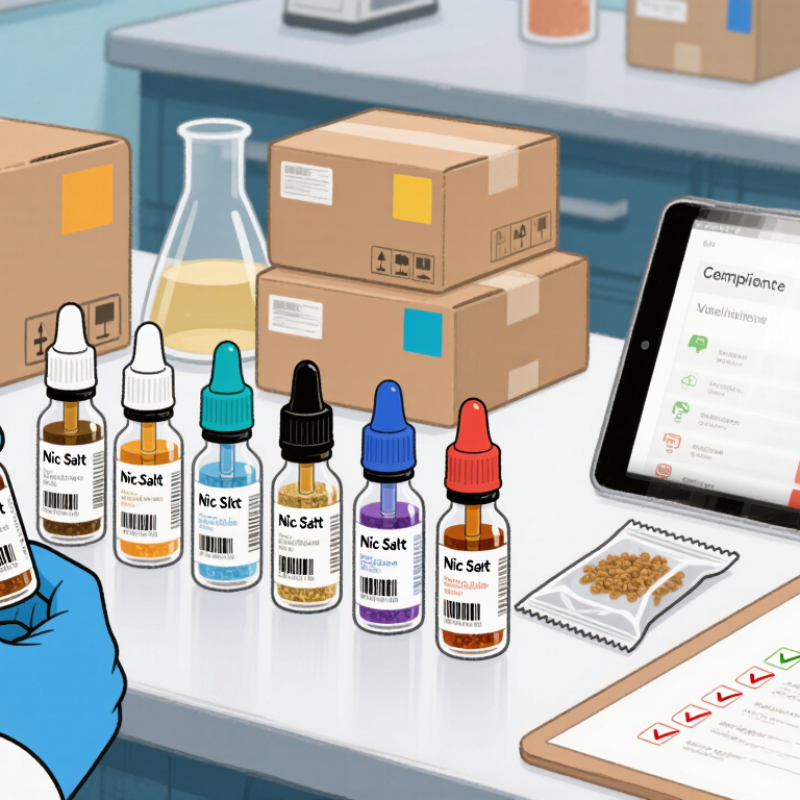
7 Best Compliance Checks for Global Nic Salt Vape Buyers

Map Target-Market Rules: EU TPD Caps Nicotine at 20 mg/mL

For buyers sourcing nicotine-salt e-liquids for EU markets, the 20 mg/mL limit is a practical checkpoint, not a label detail to review later. Under the EU Tobacco Products Directive, nicotine-containing e-liquids must not exceed 20 mg/mL. Nicotine salt does not create an exemption.

Check the concentration shown on the product specification against the retail label and laboratory documentation.

Easy to miss. A bottle marked 20 mg/mL is at the ceiling; a higher-strength sample may not meet this requirement for the EU market.

Check the exact destination country, too. EU-wide rules provide a baseline, while national requirements can affect language, warnings, notification procedures, and other packaging details.

Ask suppliers for current, product-specific records rather than relying on a general compliance statement. Compare the nicotine concentration, ingredient list, batch number, and warning text across documents and packaging.

Check the numbers. If a specification uses a different unit or leaves the strength unclear, request written clarification before placing an order.

Requirements can change, and product paperwork can lag behind. Verify details with the relevant national authority or a qualified compliance professional before shipment.

Verify Refill Packaging: EU TPD Limits Nicotine Liquid Bottles to 10 mL

For global buyers, refill-bottle size is a practical EU compliance check. Article 20 of the EU Tobacco Products Directive caps nicotine-containing refill containers at 10 mL and nicotine strength at 20 mg/mL. These are separate limits: a small bottle can still exceed the permitted concentration. The European Commission’s 2021 report on the Directive’s application reviews product-notification and packaging controls, useful context when checking supplier documents. Check each refill bottle, not only the outer carton.

Read the volume and nicotine strength on the label, then compare them with the product specification and batch documents. Look for required warnings and traceable batch details. A neat label is not proof. Ask for current EU market documentation and confirm any national requirements with a qualified compliance adviser, since rules and enforcement can differ by country. I would not rely on a supplier’s generic “EU compliant” statement alone; it leaves too much unverified. A photo of the bottle beside a measuring reference can help flag obvious discrepancies, but it cannot replace document checks or independent testing.

Check EU Notification Timing: TPD Requires Submission 6 Months Before Sale

For EU sales, timing is not a last-minute paperwork detail. Under the Tobacco Products Directive, a nicotine-containing e-cigarette product generally must be notified at least six months before it is placed on the market. The clock relates to market placement, not simply the buyer’s purchase order. Confirm the applicable process with the relevant national authority.

Before agreeing to a launch date, ask for the notification date, product identifier, and intended EU countries. Check that the submitted product details match the goods: formulation, nicotine concentration, device, and packaging. A submission receipt is useful evidence, but it does not confirm that every national requirement is met. Small differences matter.

Leave room for translation, document review, and corrections. Even careful teams miss a detail. A revised liquid formula or device specification may affect the notification file, so ask whether an update is needed and whether it changes the timeline. Keep dated copies of supplier records and compare them with the products received. Six months can feel generous on paper; it can disappear quickly when documents arrive late.

7 Best Compliance Checks for Global Nic Salt Vape Buyers — Check EU Notification Timing: TPD Requires Submission 6 Months Before Sale
# Compliance check What buyers should verify Key requirement or timing Scope / reference
1 Confirm destination-market rules Check whether nicotine e-cigarettes and e-liquids may be sold, imported, or supplied in each destination, and whether local registration, authorization, or importer obligations apply. Requirements differ by jurisdiction; EU TPD rules do not automatically apply worldwide. Destination-country legislation and regulator guidance.
2 Check EU notification timing For products covered by the EU Tobacco Products Directive (TPD), confirm that the required product notification has been submitted through the applicable EU system and that the relevant Member State requirements are met. The manufacturer or importer must submit the notification at least six months before the intended placing on the market. EU TPD, Directive 2014/40/EU, Article 20(2). Applies to covered e-cigarettes and refill containers.
3 Verify nicotine and container limits Check the declared nicotine concentration and the fill capacity of refill containers, cartridges, and tanks against the rules for the intended market. Under EU TPD Article 20(3)(b), nicotine-containing liquid must not exceed 20 mg/ml; refill containers must not exceed 10 ml; cartridges and tanks must not exceed 2 ml. EU TPD Article 20(3)(b). Check local rules separately outside the EU.
4 Review ingredients and emissions evidence Request a complete ingredient list, nicotine-content information, and supporting emissions or laboratory data. Confirm that ingredient information and test results match the product being supplied. EU TPD requires ingredients of high purity and restricts ingredients that pose specified health risks when heated or unheated; notification information includes emissions and toxicological data. EU TPD Articles 20(2) and 20(3)(d)–(e).
5 Check packaging and product safety Inspect packaging and device documentation for applicable child-resistant and tamper-evident features, leak-prevention requirements, and protection against breakage or leakage during handling. EU TPD requires child-resistant, tamper-evident packaging and protection against breakage and leakage for covered products. EU TPD Article 20(3)(g).
6 Validate warnings, labels, and instructions Check that the pack carries the required health warning, ingredient and nicotine information, batch or lot identification, storage and use instructions, and the language or languages required by the destination market. For covered EU products, the health warning must cover 30% of the two largest surfaces of the unit packet and any outside packaging, subject to the TPD provisions. EU TPD Article 20(4)(b); verify national language and implementation rules.
7 Confirm import, tax, and records obligations Before shipment, confirm product classification, importer-of-record responsibilities, customs documentation, applicable excise or other taxes, and record-retention or adverse-event reporting duties. These obligations vary by destination and can change independently of product-notification rules; confirm them with the relevant customs and tax authorities. Destination-country customs, tax, and product-regulatory requirements.
Note: “Nic salt” describes a nicotine formulation; it does not exempt a product from the rules that apply to nicotine-containing e-cigarette liquids. Confirm current requirements with the competent authority in every intended market.

Confirm U.S. Market Authorization: FDA Requires Premarket Review for New ENDS

For buyers supplying the U.S. market, FDA marketing authorization is a key check—not a box to tick after an order is placed. New tobacco products, including many electronic nicotine delivery system products, generally need FDA premarket authorization before they can be legally marketed in the United States. A submitted application alone is not authorization.

Check the exact product in FDA’s searchable tobacco product database. Compare the listed product name, manufacturer, device type, and e-liquid details with the paperwork and samples in front of you. Nicotine strength and flavor can matter; authorization for one product should not be assumed to cover every variation. Details matter. Keep dated screenshots and supplier documents, then ask for clarification when names or specifications do not match. Small differences can be easy to miss during a busy purchase.

FDA authorization is not a declaration that a product is safe or FDA-approved. It means the agency has issued a marketing order for that specific product under its review process. I would also confirm that the order remains current and applies to the intended U.S. market. This check takes time, and records are not always easy to compare. Still, a careful pause is better than relying on a vague claim of compliance.

7 U.S. FDA Compliance Checks for Global Nicotine Salt Vape Buyers

U.S. law generally requires FDA premarket authorization before a new tobacco product can be legally marketed. Use these checkpoints to screen products and supporting documentation before purchase.

How to read this chart: Each bar marks one regulatory checkpoint to verify; it is not a product pass score or a measure of authorization. Some reporting duties apply to manufacturers or importers rather than every buyer. Confirm requirements for the specific product and your role.

Check for: (1) an FDA marketing authorization order; (2) a match between the order and the exact product; (3) required nicotine warnings on packaging and advertising; (4) authorization for any modified-risk claims; (5) applicable ingredient-list submissions; (6) applicable harmful and potentially harmful constituent reporting; and (7) admissibility under U.S. import requirements. These U.S. checks do not replace destination-country rules.

Audit U.S. Age Controls: Federal Law Sets the Minimum Sales Age at 21

U.S. federal law sets 21 as the minimum legal sales age for tobacco products, including e-cigarettes. The FDA requires retailers to check photo identification for customers under 30. These rules cover nicotine-salt products too. Buyers reviewing a U.S. supplier should request written age-check procedures, staff training records, and dated audit logs. A policy sheet alone does not prove consistent practice.

The CDC’s 2024 National Youth Tobacco Survey estimated that 1.63 million U.S. middle and high school students currently used e-cigarettes. This is a public-health measure, not a count of retailer violations. Still, it shows why age controls deserve scrutiny. Ask how the seller handles failed verification, repeat orders, and delivery handoffs. Small gaps matter. Paperwork can look tidy while checkout remains uneven.

Tip: Request a redacted test-purchase report and the escalation process for failed age checks. Confirm controls at checkout and delivery, not only during account setup. Ask how procedures are reviewed against federal, state, and local rules. Recheck after platform or carrier changes. One blind spot is enough to revisit.